Fleece resistance refers to the property of textiles (such as down jackets and sleeping bags) to prevent the filling of down or feathers from protruding through the fabric surface, seams, or needle holes. Fleece phenomenon may lead to a decline in thermal insulation performance, affecting the appearance and user experience of the product. Common forms of fleece include down fibers protruding from yarn gaps and down plumes penetrating the fabric or seams.
Currently, China’s testing methods for anti-pilling performance in textiles and apparel are categorized into the friction method and the rotating box method. The primary standards include GB/T 12705.1-2024 “Textiles-Test Method for Anti-Pilling Performance-Part 1: Friction Method” and GB/T 12705.2-2024 “Textiles-Test Method for Anti-Pilling Performance-Part 2: Rotating Box Method”. Additionally, product standards such as “Down Clothing” (GB/T 14272-2021, Appendix D) and industry standards like “Knitted Down Clothing” (FZ/T 73053-2015, Appendix A) also reference GB/T 12705.2, employing the rotating box method for anti-pilling testing.
The aforementioned standard testing methods apply to textile products containing down or feathers as fillers (e.g., down jackets, down quilts) and the fabrics used in their production (including woven, knitted, and other types). Specifically, the friction method evaluates anti-pilling performance of fabrics or specific structural components, while the rotary box method is more suitable for assessing finished products or complete structures, serving as a comprehensive inspection of the final product.
Comparison of the test principles of two detection methods
Principle of friction test: Fabric samples are prepared as test bags of specific dimensions, either filled with a predetermined mass of down filling or directly cut into predefined test bags. These test bags are placed in a plastic bag and mounted on the instrument. Through processes such as compression, kneading, and friction, the anti-pilling performance of the fabric or down product is evaluated by counting the number of feathers, down, down fibers, and down roots that emerge from the interior of the test bag.
The transfer box method operates on the following principle: Fabric samples are first packaged into size-specific test bags containing a predetermined quantity of down filling material, or the down products themselves are used as specimens. These samples are then placed inside a rotating box equipped with rubber balls in a down-resistant testing machine. The box’s continuous rotation elevates the rubber balls to a specific height, which impacts the sample to simulate real-world compression, friction, and impact forces experienced by down products during use. The down-resistant performance of the fabric or down product is evaluated by counting the number of feathers, down fibers, down filaments, and down roots that escape from the sample bag or interior.
YG819 Fabric Drilling Performance Tester
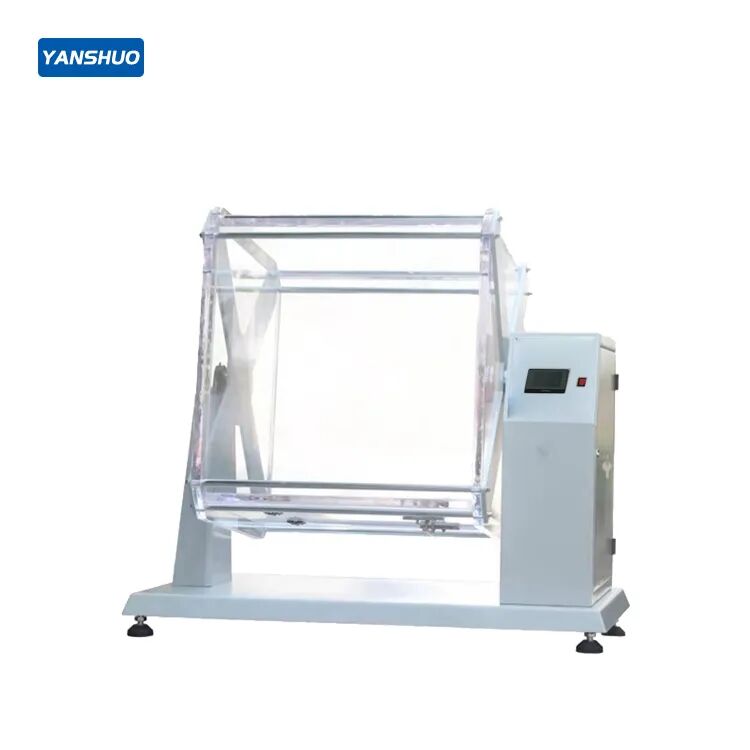
Comparison of Equipment and Materials for Two Detection Methods
| Test method | major installation | Other equipment |
| Friction Method | Anti-pilling test machine Key technical specifications: Plaque dimensions: (180±2) x (80±2) mm; Plaque spacing: adjustable (5-60 mm); Rotation speed: 135±1 rpm | Thickness tester (with measurement accuracy of 0.1mm, pressure plate dimensions (160±2)mmx (180±2)mm, and sample pressure (14.7±0.2)N), balance (precision 0.01g), steel ruler (1mm), sewing needle and thread, down feather filling, electric heat gun, plastic bag (smooth surface, no wrinkles, transparent, single-layer thickness (25±2)mm x (30±1)cmx (28±1)cm) |
| Transfer box method | Anti-pilling Test Machine (Small Box) Key technical specifications: Box dimensions: 45±0.8cm on each side; Square shape; Rotational speed: 45±1 rpm | Rubber balls (Type A, Type B, Type C), electronic balance (precision 0.01g), steel ruler (1mm), sewing needle, sewing thread, down feather filling material, electric heating gun |
| Anti-pilling Test Machine (Large Box) Main technical specifications: Box dimensions: square with side length 60±1 cm; Rotational speed: 42±1 rpm | Rubber balls (Type A, Type B, Type C), electronic balance (precision 0.01g), steel ruler (1mm), sewing needle, sewing thread, down feather filling material, electric heating gun |
Comparison of testing procedures and parameters between the two detection methods
| Test method | Test steps | test parameters | |
| Friction Method | 1. Prepare sample bags (including fabric and down/fur product bags); 2. Measure bag thickness using a thickness tester; 3. Adjust the testing interval on the testing machine based on the measured thickness; 4. Place the sample bags in plastic bags and secure them to the testing machine, then initiate reciprocating friction; 5. Count the feathers, down, downy fibers, and downy fibers protruding more than 2mm from the bag surface, as well as the number of feathers, down, downy fibers, and downy fibers inside the plastic bags. | Rounds: 2700 | |
| Transfer box method | 1. Sample preparation (including fabric sample bag preparation, product sample bag preparation, and sample preparation for overall product testing); 2. Place the sample into the rotating chamber and add rubber balls; 3. Set the rotation speed and activate the instrument; 4. Remove the sample bag or overall test sample, inspect and count feathers, down, down fibers, and down roots protruding from the surface of the sample bag or overall test sample by more than 2mm, then inspect and count the feathers, down, down fibers, and down roots inside the rotating chamber and on the rubber balls. | condition A | Sample bag or complete down jacket with a length of ≤40 cm, small box testing machine, 10 Type A balls, rotational speed (45+1) r/min, forward rotation 1440 times |
| condition B | Complete down jacket with a length>40cm, large box-type testing machine, 15 Type A balls, rotational speed (42±1) r/min, forward rotation 1440 times | ||
| condition C | Small box testing machine, 16 B-type balls, rotational speed (45±1) r/min, forward rotation 1440 revolutions | ||
| condition D | Large box-type testing machine, 24 B-type balls, rotational speed (42±1) r/min, forward rotation 1440 revolutions | ||
| condition E | Small box testing machine, 10 C-shaped balls, rotational speed (45±1) r/min, forward rotation 1000 times | ||
Comparison of the calculation and evaluation of the two detection methods
In the calculation of pile number, GB/T 12705.1 friction method requires separate calculations of the pile number in the warp and weft directions (longitudinal and transverse) and reporting them separately by direction; GB/T 12705.2 rotary box method uses the arithmetic mean of the pile numbers from two sample bags as the final result, while the overall test sample’s result is taken as the final outcome.
The two methods are the same in the evaluation index of anti-pilling.
| Test method | Count | Evaluating indicator |
| GB/T12705.1 Friction Method | For fabric samples, the average number of warp and weft pile counts was calculated respectively; for finished product samples, the number of vertical and horizontal pile counts was recorded respectively. | ≤5 strands: exhibits excellent anti-pilling properties; |
| 6~15 roots: with anti-pilling property; | ||
| ≥16 strands: poor anti-pilling performance | ||
| GB/T12705.2 Transfer Box Method | The arithmetic mean of the root count from two sample bags is taken as the final result, and the overall test sample is evaluated based on the test results as the final outcome. | ≤5 strands: exhibits excellent anti-pilling properties; |
| 6~15 roots: with anti-pilling property; | ||
| ≥16 strands: poor anti-pilling performance |
The anti-pilling performance standard in GB/T 14272-2021 “Down Clothing” specifies ≤40 pilling fibers per m² for premium-grade products, ≤70 for first-grade products, and ≤120 for qualified products. The textile industry standard FZ/T 73053-2015 sets the limit at ≤15 for premium-grade, ≤30 for first-grade, and ≤50 for qualified products.
When purchasing down products for daily use, it is recommended to choose those with high-density fabric or anti-pilling coatings. During regular wear and use, avoid contact with sharp objects to minimize friction and compression. For washing and maintenance, opt for gentle hand washing or professional cleaning, and refrain from dry cleaning. Store in a dry place and avoid heavy pressure to effectively reduce pilling in down products.